
Table of Contents
Toggle“Marketing is no longer about the stuff you make, but the stories you tell.” Seth Godin nailed it, and in 2025, it’s more true than ever.
Scroll fatigue is real. People don’t remember stats. They remember stories. That one email that made them laugh. The brand that made them feel seen. The founder video that sounded like an actual human being instead of another mission-statement smoothie.
Here’s the truth: storytelling in marketing isn’t some fluffy, creative indulgence. It’s a strategic edge. It builds trust. It drives conversions. It’s the difference between ignored and shared.
And yet, most brands are still stuck telling the wrong story, or worse, making themselves the hero. Which is like showing up to someone else’s birthday party with a slideshow about your career.
This guide is your fix. You’ll learn how to tell stories that actually resonate, structure them properly, and apply them across digital channels without sounding like you’re reading from a whitepaper.
Let’s turn your marketing from background noise into something people want to engage with. Grab a coffee. This one’s worth the read.
Why Storytelling Works in Marketing
Let’s start with brains. Human ones.
We’re wired to respond to stories. Literally. Our brains light up when we hear a narrative, especially one with tension, emotion, and resolution. It’s not just about “engagement.” It’s about biology. A good story activates more brain regions than a bullet point list ever will.
Storytelling in marketing works because people don’t want more data. They want meaning. They want to see themselves in the journey. They want to feel something before they make a decision. Whether you’re selling project management software or artisan socks, emotion moves the needle more than specs.
It’s also a trust builder. When you tell a story well, people drop their guard. You become relatable. Memorable. Trusted. And in a world where no one trusts ads, that’s everything.
This isn’t fluff. This is strategy. Just ask HubSpot, the AMA, or any marketer who’s been in the field for more than five minutes. Storytelling wins. Period.
The Anatomy of a Great Brand Story
Here’s the mistake most brands make: they think they are the main character.
Spoiler: you’re not. The customer is.
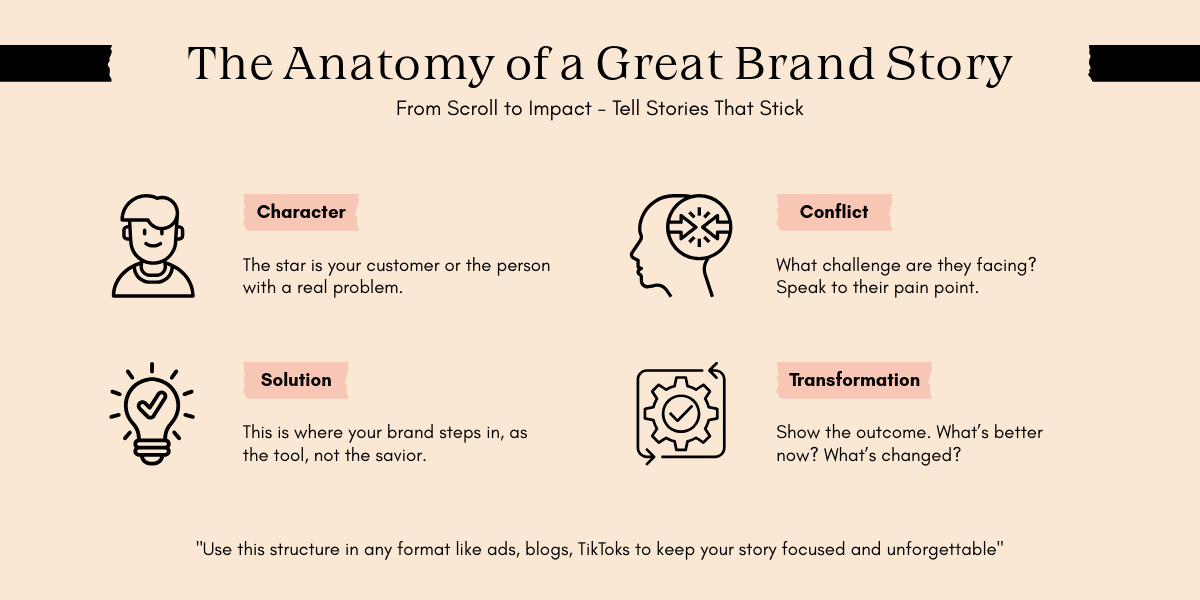
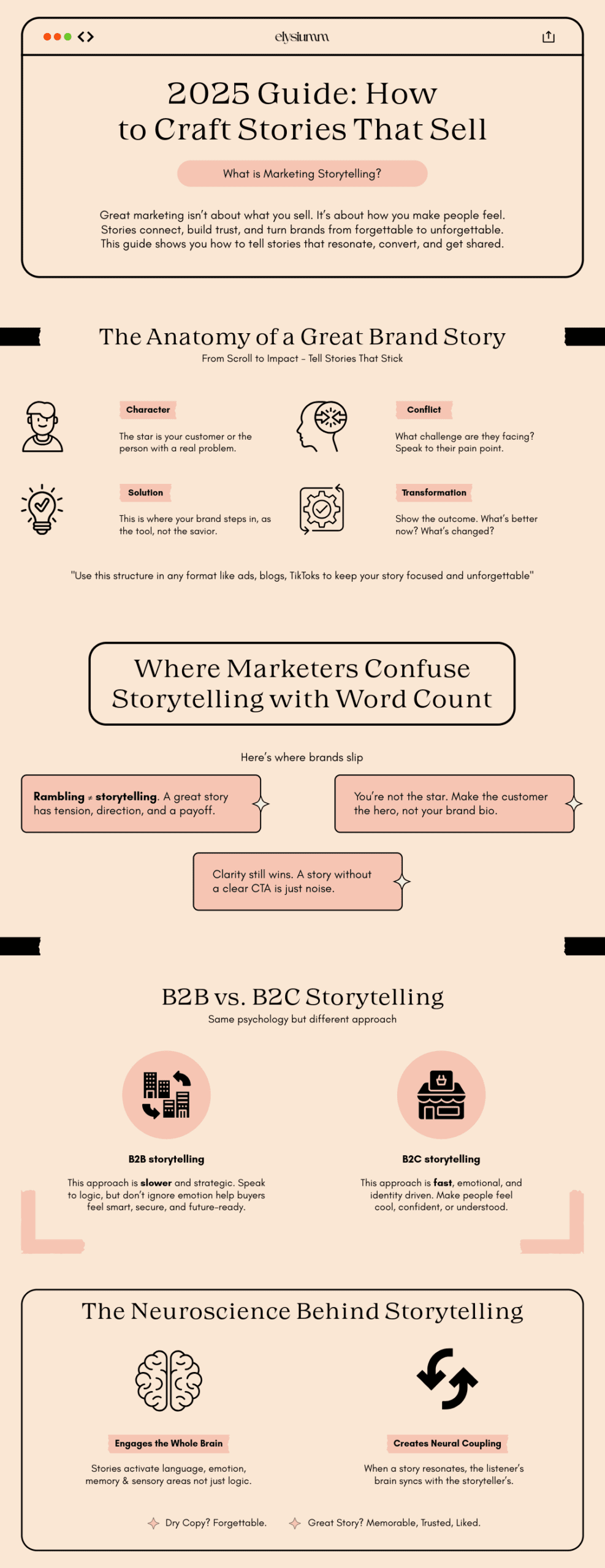
Every strong story has four essentials. Doesn’t matter if it’s a Pixar film or a product page.
1. Character
That’s your customer. Not your CEO. Not your brand mascot. The human being with a problem they care deeply about.
2. Conflict
This is the tension. The pain point. The challenge. What keeps them up at night. Don’t water this down—conflict is what makes people pay attention.
3. Solution
Now you come in. Not as the hero, but as the guide. Your product, your service, your team—this is the tool that helps the customer overcome the conflict.
4. Transformation
Paint the after. What does success look like? What changed? What’s different in their life, business, or mindset?
Whether you’re writing an ad, a blog, or a TikTok script, this basic structure keeps your message clear and your audience hooked.
Storytelling in Digital Marketing (With Examples)
Storytelling isn’t one-size-fits-all. It bends and shifts depending on the platform. Let’s break it down.
Email: Forget “quick update” subject lines. Start with a story. A real one. Someone’s aha moment. A customer meltdown that turned into a win. Narrative flows keep people reading. Especially in welcome sequences and launch emails.
Social: The best content here feels like a mini-series. Tell stories in parts. Use behind-the-scenes footage, founder anecdotes, or origin moments. Instagram, TikTok, and LinkedIn love this stuff, especially when it’s honest, not polished.
Video: Video is emotional storytelling in 4K. Use cinematic arcs, even if it’s just a two-minute explainer. Make it personal. Make it human. Voiceover stories of transformation work better than polished product demos.
Blog and content marketing: Treat your customer journey like a story. Don’t just outline benefits, narrate a situation. Use hooks, tension, pacing. Wrap your how-to guide in a transformation arc. The best content doesn’t just teach, it makes people feel smarter, braver, or understood.
And yes, it works. Brands use these tactics every day. Sites like ReferralCandy track examples of brands that do it well. You don’t need to copy, just learn the rhythm.
Storytelling vs. Selling: Where Brands Go Wrong
This is where a lot of marketers fall off the rails.
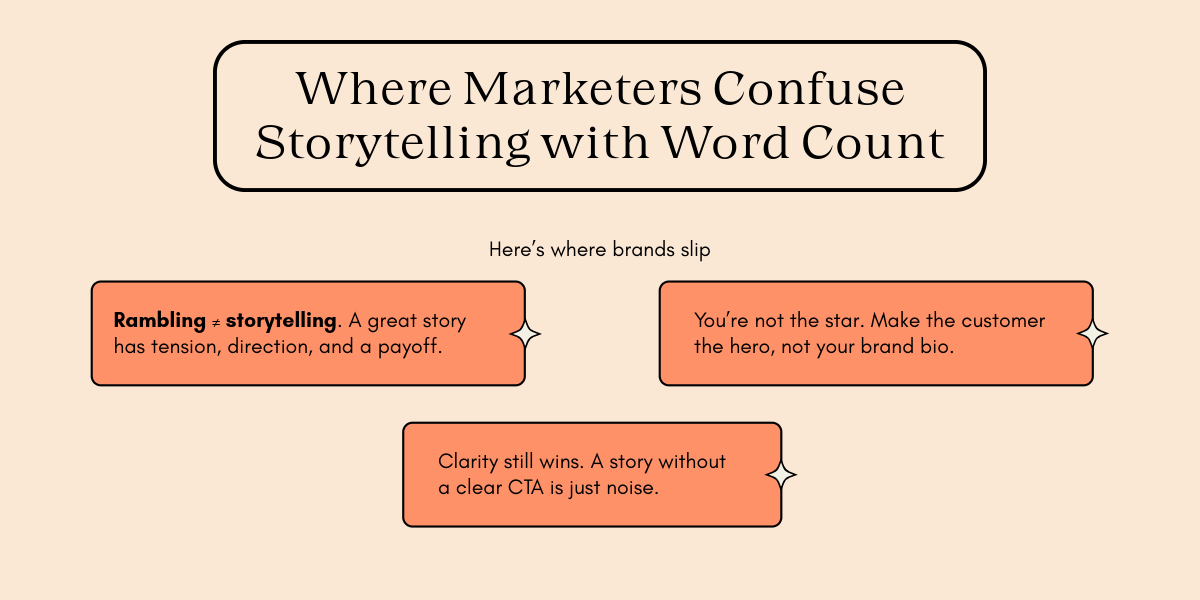
They confuse storytelling with writing more words. Or worse, rambling without structure. A story is not just an origin tale or a quirky brand voice. It’s a crafted arc with tension, flow, and a payoff.
Another mistake? Making yourself the star. If your “About” page is a 900-word monologue about your vision without showing how you solve a customer problem, it’s not a story, it’s a resume.
And let’s be clear: storytelling isn’t an excuse to skip clarity. Yes, tell a story. But also give the offer. Make the CTA clear. Guide the reader toward an action, not just applause.
Your audience isn’t here to hear how clever you are. They’re here to solve a problem. Don’t just entertain, connect. And then convert.
Storytelling Frameworks You Can Steal
You don’t need to reinvent anything. Great stories have patterns. Here are a few that just work.
Before, After, Bridge
Where your customer is now → where they want to be → how you get them there. Simple, clean, powerful.
Problem, Agitate, Solve
Start with the pain. Twist the knife (a little). Then present your solution. This works brilliantly in copywriting, especially emails and landing pages.
Hero, Obstacle, Guide, Victory
Your customer is the hero. The problem is the obstacle. You’re the guide. The win is the transformation. Feels cinematic, and it works across formats.
Use these as outlines, not templates. Make them yours. But stick to the shape. Structure creates clarity.
How to Build a Story-First Marketing Strategy
Storytelling isn’t a tactic. It’s a lens.
Start with your audience’s story. Who are they? What do they want? What’s in their way? Map this out. Get clear on their pain and their potential.
Then look at your brand story. Not the origin story, but the role you play. Are you the guide? The disruptor? The best-kept secret? Choose a narrative stance and stay consistent.
Now build your content around story arcs, not just topics. If you’re writing blog posts, ask: what journey is this piece taking the reader on? If you’re launching a product, ask: what chapter of their life does this open?
Use your voice. Speak like a human. And repeat your core narrative across touchpoints. Don’t make every ad tell a different story. Consistency builds trust.
And make space for emotion. Especially in digital. Because facts tell. Stories sell.
B2B vs. B2C Storytelling: What Changes?
Storytelling isn’t just for DTC brands with quirky mascots and lifestyle montages. It works in B2B too, you just have to shift the lens.
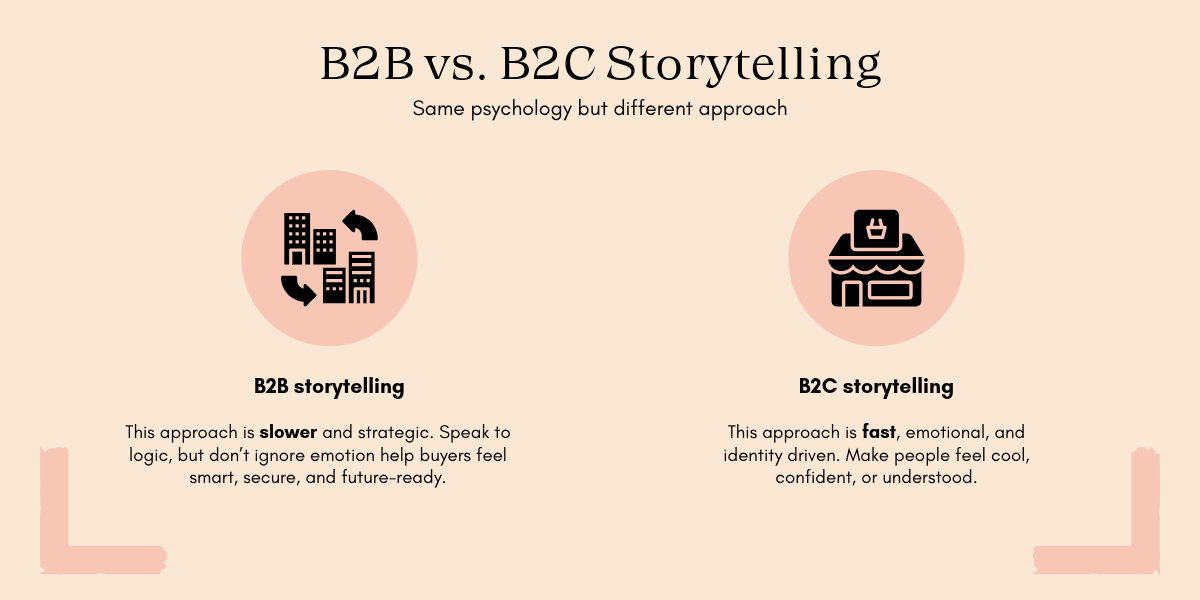
In B2C, stories tend to be emotional, fast-paced, and built for entertainment or identity. You’re tapping into how someone wants to feel: cool, confident, secure, admired. It’s personal.
In B2B, the stakes are higher, and the stories are different. You’re speaking to a team, a budget, a bottom line. But it still comes down to humans making decisions. People want certainty, yes, but they also want to feel smart, innovative, and safe.
The trick? Use storytelling to de-risk the decision. Highlight transformation, not just specs. Talk about outcomes, not just features. Make the buyer the internal hero, the one who brought in the solution that worked.
Different pace. Same psychology.
Real-Time Storytelling in 2025
The game has changed. Your audience doesn’t just consume stories, they live inside them now.
In 2025, real-time storytelling means:
- Reposting a customer’s success as it happens
- Turning support tickets into testimonials (with permission)
- Going live during a launch, sharing behind-the-scenes chaos
- Letting your brand voice evolve in the moment, not on a quarterly schedule
Social platforms are fast. Messaging apps are faster. AI is generating micro-narratives on demand. That means your story isn’t static anymore, it’s a living, breathing thing.
Be ready to pivot. Be transparent. Be human. Because your audience isn’t waiting for your polished Q2 campaign. They’re reacting to your story right now.
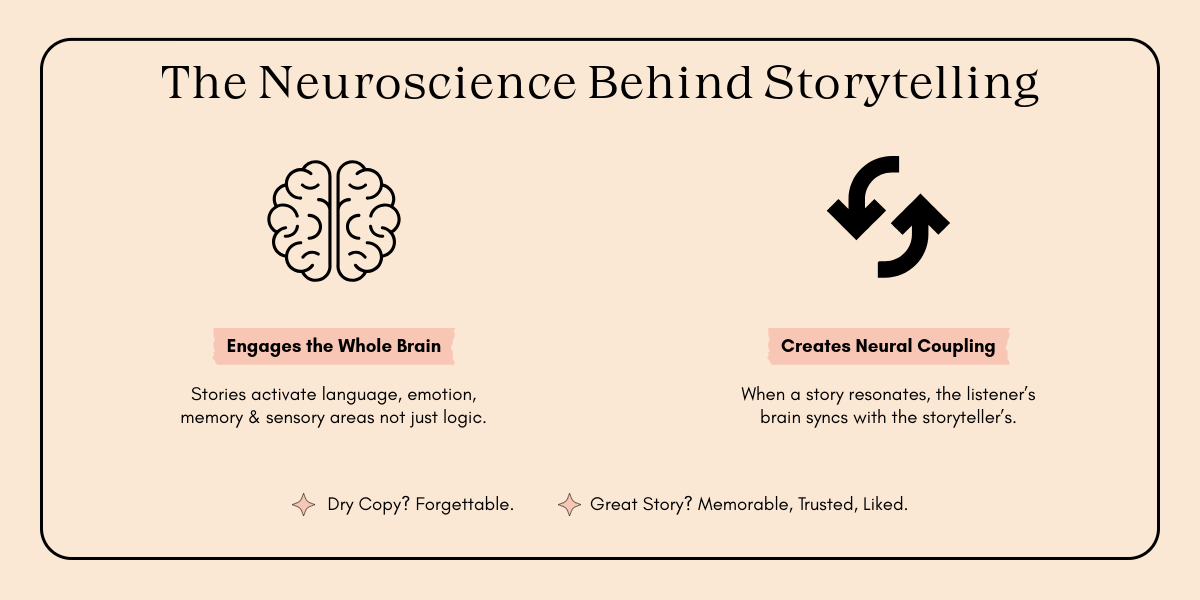
The Neuroscience Behind Storytelling
Let’s nerd out for a second, because this explains why storytelling is so powerful.
Stories activate more than just the language center in our brains. They trigger sensory areas, motor responses, and emotional memory. The result? Your message sticks.
Even more interesting: when a story is compelling, the listener’s brain activity starts to sync with the storyteller’s. It’s called neural coupling. It’s literally connection on a neurological level.
Translation? If your landing page reads like an owner’s manual, no one’s brain is syncing. But tell a story that’s visual, emotional, and structured, and suddenly you’re remembered. Trusted. Even liked.
That’s what stories do. They bypass resistance. And in marketing, that’s the win.
Conclusion
Here’s the thing about storytelling in marketing: it’s not a bonus feature. It’s the whole operating system.
You can have the best product on the planet. But if no one understands how it fits into their life, they won’t care. And if they don’t care, they won’t click, buy, or remember you.
That’s why the best marketers in 2025 aren’t just writing copy. They’re crafting arcs. They’re building tension. They’re positioning their customers as heroes, not themselves. And when done right? Storytelling doesn’t just inform. It converts.
So go back to your next campaign. Your next email. Your next pitch deck. And ask: what’s the story here? Who’s it for? What do they feel by the end?
Because strategy without story is forgettable. But a good story? That’s how brands become memorable, and how marketing becomes magnetic.
FAQ
Storytelling in marketing is the use of narrative techniques to connect with audiences emotionally, build brand identity, and inspire action. It transforms brand messages into relatable, memorable stories that engage customers, foster trust, and drive conversions through meaningful content.
The 4 P’s of storytelling are People, Place, Plot, and Purpose. These elements help create compelling narratives: People (characters), Place (setting), Plot (sequence of events), and Purpose (message or takeaway). Together, they shape engaging stories that resonate with audiences and support marketing goals.
The 5 C’s of storytelling are Circumstance, Curiosity, Characters, Conversations, and Conflict. These components build engaging stories: Circumstance sets the context, Curiosity draws interest, Characters drive action, Conversations reveal emotions, and Conflict creates tension that keeps audiences invested in the narrative.
The 5 P’s of storytelling are People, Place, Purpose, Plot, and Progress. These elements guide story structure: People (who), Place (where), Purpose (why), Plot (what happens), and Progress (how it unfolds). Together, they craft compelling narratives that connect emotionally and drive audience engagement.